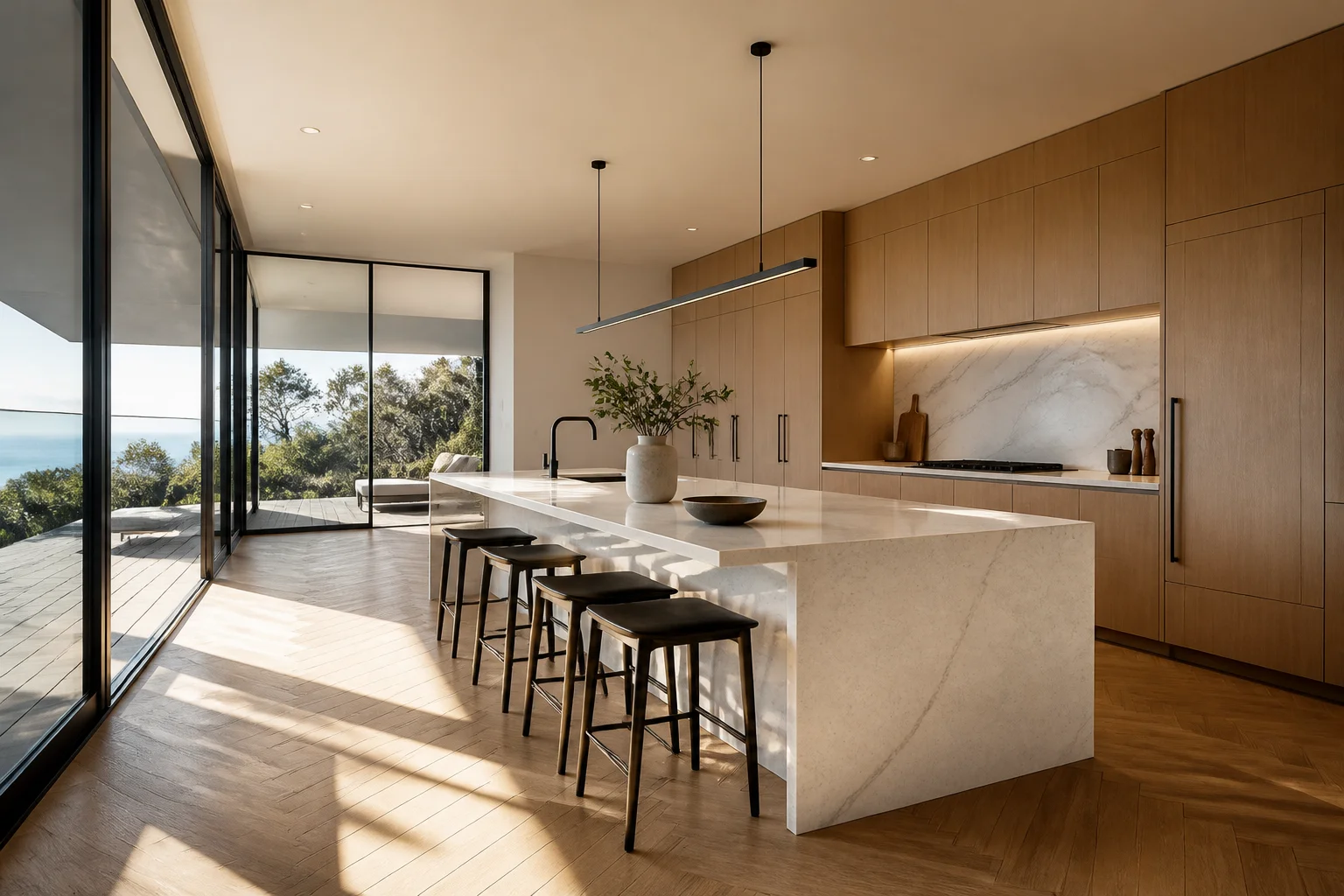
When managing residential villa and commercial development projects, the most expensive mistake is rarely paying 3% to 5% more on the unit price of a product. The real project killer is the hidden cost iceberg—managing 10 to 15 disconnected Chinese factories, coordinating incompatible shop drawings across different trades, absorbing port demurrage fees from delayed containers, and dealing with suppliers blaming each other when a custom door frame doesn’t fit the wall opening on site.
On real international construction jobs across 100+ countries, I have seen both procurement models succeed and fail. Sourcing directly from specialized factories can look enticing on an initial pro forma invoice, but landed cost and installed performance tell a completely different story.
In this guide, I break down the practical comparison between Sourcing Directly from Multiple Factories and Partnering with a One-Stop Building Material Supplier in China. You will see a transparent analysis of total cost of ownership (TCO), drawing and tolerance coordination, container packaging, and warranty recourse—so you can make an informed procurement decision tailored to your project scale and budget.
Executive Summary: Multi-Factory Sourcing vs. One-Stop Turnkey Procurement
| Comparison Dimension | Direct Multi-Factory Sourcing | One-Stop Turnkey Procurement (George Group) | Impact on Project Outcome |
|---|---|---|---|
| Initial Quotation (FOB) | Appears 5%–10% lower per item | Comprehensive unified project quotation | Initial invoices hide multi-party consolidation costs |
| Total Landed Cost (TCO) | Often 15%–25% higher due to fragmented fees | Predictable, fixed budget with volume consolidation | Eliminates demurrage, duplicated shipping marks & LCL surcharges |
| Architectural Coordination | Buyer/Architect must coordinate 10+ factory CADs | Dedicated engineering team aligns all shop drawings | Prevents cabinet/appliance and window/wall rough-opening clashes |
| Quality Control (QC) | Buyer hires 3rd-party inspectors for each city | Centralized pre-shipment assembly & dry-lay inspection | Full-house mockup check before loading |
| Logistics & Customs | 5–10 separate LCL bills of lading (B/L) | Single B/L in consolidated 40HQ containers | Saves thousands in port destination charges & clearance fees |
| Delivery Timeline | Bottlenecked by the slowest factory | Synchronized production schedules & staged delivery | Guarantees overall project schedule adherence |
| Warranty & After-Sales | Disconnected suppliers shift blame for defects | Single Point of Responsibility for the entire build | Clear accountability and 5-year structural warranty backing |
| Ideal Project Fit | Bulk commodity orders of a single category (e.g. 50 containers of identical tiles) | Custom villas, multi-family apartments, hotels, and full-house residential projects | High design complexity demands unified execution |
1. Direct Sourcing from Multiple Factories: The Illusion of the “Factory Price”
Direct factory sourcing is the traditional approach: an overseas developer or architect travels to different manufacturing clusters—Foshan for tiles and sanitary ware, Zhongshan for lighting, Dongguan for furniture, and Huzhou for wooden flooring—negotiating separate purchase orders with each specialized facility.

Advantages:
- Direct Price Negotiation on Single Commodities: When purchasing huge volumes of a single SKU (such as 20,000 m² of standard ceramic tiles), negotiating directly with an automated tier-1 manufacturer can yield marginal unit price discounts.
- Specialized Production Insights: Visiting specialized facilities gives buyers deep visibility into specific raw material grades (e.g., thermal-break aluminum extrusion alloys or porcelain slip-resistance ratings).
Hidden Costs & Disadvantages:
- Fragmented Communication Overload: Managing 10 factories means dealing with 10 different sales representatives, 10 production queues, 10 payment terms, and 10 sets of export documentation.
- The “Zero Cross-Trade Coordination” Trap: A kitchen cabinet factory in Shunde will not communicate with your built-in appliance supplier in Ningbo. If the cabinet carcass opening is cut 5mm too narrow, neither factory accepts responsibility.
- Multi-City Quality Inspection Travel: To ensure standards, you must either fly between multiple provinces in China or hire third-party inspection agencies (e.g., SGS, Bureau Veritas) at $300–$500 per factory visit, rapidly eroding initial price savings.
- Staggered Completion & Warehouse Demurrage: Factory A finishes cabinets on Day 30; Factory B finishes aluminum windows on Day 50; Factory C delays bathroom vanities to Day 75. You must either pay local warehouse storage fees in China or ship multiple half-empty containers, multiplying ocean freight expenses.
Field Rule of Thumb: Direct multi-factory sourcing only saves money when buying high-volume, low-variety commodity goods. The moment your project involves customization, aesthetic matching, and cross-category joinery, the communication friction and consolidation costs far outweigh unit savings.
2. One-Stop Turnkey Procurement: The Integrated Supply Chain Model
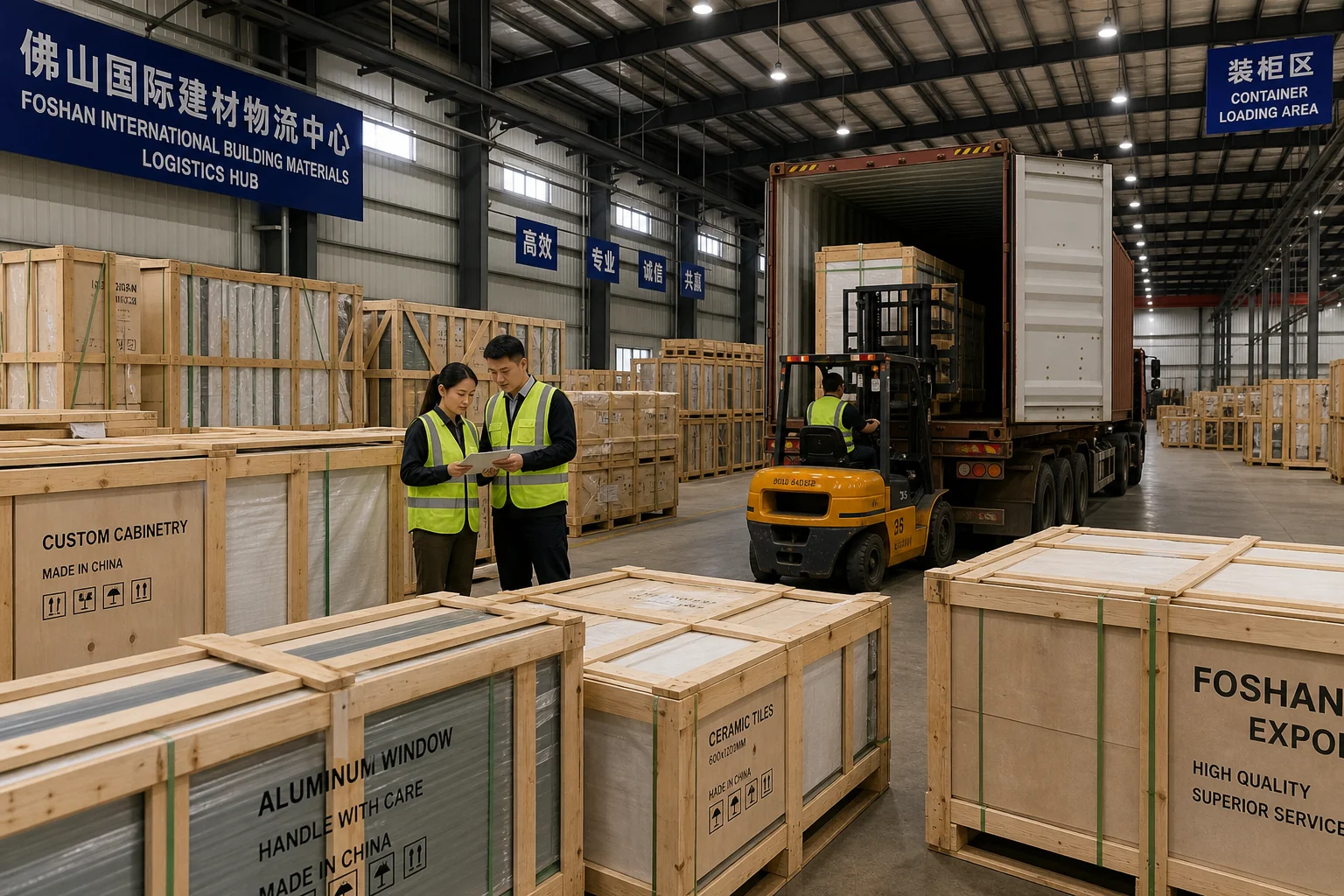
One-stop building material procurement integrates architectural interior design, multi-category manufacturing, centralized quality control, container consolidation, and international export clearance under a single unified partner.
Advantages:
- End-to-End Architectural Shop Drawing Alignment: A unified engineering team reviews your complete architectural floor plans and structural sections. CAD drawings for kitchen cabinetry, wardrobe layouts, window rough openings, and sanitary plumbing lines are cross-verified before any factory cuts material.
- 100,000+ m² Showroom & Manufacturing Campus: Instead of traveling across four provinces, overseas buyers review complete mockups, physical material boards, tile finishes, door hardware, and cabinet finishes under one roof in Foshan, China.
- Centralized QC & Pre-Assembly Dry-Lay: Custom cabinetry, vanity counters, and staircase sections undergo factory pre-assembly inspection to verify joint tightness, hardware tolerances, and finish consistency prior to crating.
- Container Loading Optimization (Full 40HQ Efficiency): Heavy goods (marble, porcelain tiles, stone) are calculated by weight and positioned on the container floor; volumetric goods (custom kitchen cabinets, wardrobes, sofas) are packed above. This maximizes container volume utilization up to 95%+, cutting ocean freight per cubic meter significantly.
- Single Bill of Lading (Single B/L) Customs Clearance: You receive one commercial invoice, one packing list, and one Bill of Lading. At destination port, your customs broker processes one import declaration, avoiding duplicate terminal handling charges (THC) and entry documentation fees.
- Single Point of Warranty Recourse: If an issue arises during on-site installation, you deal with one dedicated project manager rather than chasing multiple suppliers across different cities.
Considerations:
- Requires Upfront Project Detail: To quote accurately, a one-stop provider requires clear architectural floor plans, elevations, and a preliminary Bill of Quantities (BOQ).
- High Selection Standard: You must partner with an established operator equipped with physical showroom scale, in-house CAD teams, and verified global export experience (such as George Group’s 100+ country delivery footprint).
Field Rule of Thumb: For custom villas, luxury residences, boutique hotels, and multi-unit developments, one-stop procurement reduces total landed procurement costs by 15% to 22% while slashing project management hours by over 70%.
3. The 4 Core Engineering & Financial Comparison Dimensions
Dimension 1: Total Cost of Ownership (TCO) Breakdown
Most international developers underestimate the “Landed Multiplier”—the difference between the factory quote and the final installed cost at the jobsite.
Total Landed Cost = Factory Cost (FOB) + Inspection Fees + Inland Freight + Warehouse Consolidation
                   + Ocean Freight + Terminal Handling & Clearance + Jobsite Rework Contingency
Real-World Cost Simulation: 5-Bedroom Luxury Villa Procurement ($120,000 Material Budget)
| Expense Category | Model A: Sourcing from 8 Disconnected Factories | Model B: One-Stop Turnkey Procurement (George Group) | Savings & Risk Reduction with One-Stop |
|---|---|---|---|
| Product Unit Cost (FOB) | $108,000 (Apparent 10% saving) | $120,000 (Comprehensive unified quote) | Direct factory looks $12,000 cheaper upfront |
| Shop Drawing Review & CAD Coordination | $3,500 (Hired external CAD draftsman) | Included ($0) (In-house engineering team) | Unified CAD eliminates misaligned openings |
| Factory Inspection Travel & QC Fees | $4,200 (8 factory visits / 3rd-party inspector) | Included ($0) (Full-course internal QC & video) | Rigorous pre-shipment dry-lay checks |
| Inland Freight to China Port | $3,800 (8 separate LTL trucking deliveries) | $1,200 (Centralized dispatch to Foshan hub) | -$2,600 (Optimized domestic routes) |
| Temporary Warehousing & Consolidation | $2,400 (Commercial warehouse 45-day storage) | Included ($0) (Integrated consolidation yard) | -$2,400 (Zero storage penalties) |
| Ocean Shipping & Container Utilization | $14,000 (3 x 20GP containers due to poor packing) | $9,500 (1 x 40HQ + 1 x 20GP tightly packed) | -$4,500 (Weight/Volume density matching) |
| Destination Port Clearance & Terminal Fees | $3,200 (8 separate customs entries & THC) | $950 (Single commercial invoice & B/L) | -$2,250 (Single customs declaration) |
| Site Rework & Tolerance Remediation | $6,500 (Remaking misaligned cabinet filler strips) | $800 (Minor routine adjustments) | -$5,700 (Precision factory pre-fit) |
| Total Real Landed Cost | $145,600 | $132,450 | Total Net Saving: $13,150 (9.0% Cheaper) + 120 Hours Saved |
Dimension 2: Cross-Category Architectural Drawing & Tolerance Coordination
In building construction, trades never exist in isolation:
- Window Frames & Exterior Cladding: Aluminum window sub-frames must match the exact reveal depth of exterior stone or siding panels.
- Kitchen Cabinets & Built-In Appliances: European or American standard appliances require specific cavity ventilation gaps, electrical rough-in heights, and gas inlet clearances.
- Bathroom Vanities & Plumbing Rough-Ins: Wall-hung toilet carriers and vanity drains must align with prefabricated wall access panels.
When sourcing from disconnected factories, tolerance coordination defaults to the buyer. If an error occurs, the cabinet factory claims their carcass followed the approved cut sheet, while the appliance supplier claims their spec was standard.
With George Group’s one-stop model, our engineering department creates a Unified Shop Drawing Package. All trades are cross-checked against your primary architectural CAD model before production release.
Dimension 3: Logistics, Container Optimization & Single Bill of Lading (Single B/L)
Shipping building materials internationally requires careful balancing of cargo weight and cargo volume:
- Heavy Density Cargo: Tiles, sintered stone, natural marble, sanitary ware, and metal structural parts hit maximum container weight limits (approx. 26 to 28 metric tons for a 40HQ) long before filling the physical cubic space.
- Volumetric Cargo: Custom kitchen cabinets, wardrobes, bathroom vanities, interior doors, and architectural lighting take up high volume but carry relatively light weight.
When purchasing from separate factories, you either ship heavy goods in half-empty containers (paying for unused air) or pay exorbitant Less-than-Container-Load (LCL) consolidation fees.
A centralized one-stop logistics hub pairs heavy tiles with volumetric cabinetry in the same container, optimizing both weight and volume thresholds to achieve maximum container payload efficiency.
Dimension 4: Single Point of Warranty Recourse vs. Multi-Party Blame Shifting
Consider this common site scenario: A luxury master bathroom is delivered. When the freestanding bathtub is installed, the floor-mounted mixer tap has incompatible thread sizing, and the stone vanity top cutout does not clear the basin trap.
- Multi-Factory Sourcing Reality: You contact the stone supplier, the faucet factory, and the sanitary ware company. All three defend their independent products. Resolution takes weeks, delays local trades, and incurs emergency replacement costs.
- One-Stop Turnkey Reality: You notify your single George Group project manager. Because all components were modeled and sourced together, replacement parts or corrective joinery components are dispatched under warranty with zero administrative disputes.
4. Practical Decision Framework: Which Sourcing Model Fits Your Project?

To select the most efficient procurement route, evaluate your project against this 4-step checklist:
Choose Direct Multi-Factory Sourcing IF:
- ✔ You are purchasing large commercial quantities of a single, standardized product (e.g., 50,000 m² of identical porcelain tile for a municipal subway project).
- ✔ Your company maintains a permanent procurement office and full-time bilingual QC inspectors in Guangdong Province, China.
- ✔ Products require zero cross-trade architectural coordination or design matching.
- ✔ You have established local bonded warehousing and dedicated freight forwarders in major Chinese ports.
Choose One-Stop Turnkey Procurement IF:
- ✔ You are building a custom private villa, luxury apartment building, residential development, or boutique hotel.
- ✔ You require whole-house harmonized aesthetics across cabinetry, doors, windows, flooring, and sanitary ware.
- ✔ You want a single commercial invoice and Single B/L for seamless destination customs clearance.
- ✔ You need professional CAD drawing review to eliminate on-site rough-opening clashes.
- ✔ You value guaranteed container consolidation, rigorous pre-shipment dry-lay inspection, and a single warranty partner.
5. Frequently Asked Questions (FAQ)
Q1. Does a one-stop building material supplier manufacture everything in one single factory?
No legitimate company manufactures tiles, aluminum windows, custom cabinetry, and chandeliers in a single plant. A premier one-stop supplier operates specialized proprietary manufacturing bases (such as George Group’s custom joinery and cabinet production) while tightly managing an integrated ecosystem of audited tier-1 partner plants in Foshan. All products pass through a centralized quality control center and consolidation logistics hub.
Q2. Is one-stop building material procurement more expensive than factory-direct?
On initial FOB unit prices, a one-stop provider may appear 3%–5% higher than an isolated local workshop. However, when factoring in eliminated 3rd-party inspection fees, optimized container shipping (saving $3,000–$6,000 per 40HQ), single customs clearance entry, and near-zero on-site rework costs, the Total Cost of Ownership (TCO) is typically 12% to 20% lower.
Q3. How does George Group ensure custom cabinets and doors fit my site dimensions?
Before manufacturing begins, our architectural team reviews your structural floor plans and verifies rough openings. We generate comprehensive 3D shop drawings with exact millimeter elevations, filler strip allowances, and appliance cutout specs for your sign-off.
Q4. Can I customize materials, finishes, and hardware brands?
Yes. You can specify exact wood veneers, matte lacquer colors, sintered stone textures, aluminum thermal-break profiles, glass coatings (Low-E, triple-glazed), and premium European hardware (Blum, DTC, Hettich, Hafele).
Q5. How are mixed materials protected during international sea freight?
Every material category receives tailored export-grade packaging: custom cabinetry and stone countertops are reinforced in solid fumigated plywood crates with high-density EPE foam corner protectors; aluminum windows feature protective PE film and corner guards; sanitary porcelain is packed in heavy-duty honeycomb cartons.
Q6. What happens if a piece arrives damaged or with incorrect dimensions?
Because George Group takes full-chain responsibility, any verified manufacturing defect or transit damage is expedited through emergency priority production and air-freighted or dispatched on the next available vessel at our expense.
Q7. How long does the entire procurement and shipping cycle take?
Standard production for customized joinery, windows, and whole-house materials takes 30 to 45 days following final shop drawing confirmation. Ocean freight typically takes 18–25 days to the Middle East, 22–30 days to Europe and Australia, and 25–35 days to North America.
Q8. Can I inspect the products in China before they are loaded into containers?
Absolutely. Clients are welcome to visit our 100,000+ m² Foshan headquarters showroom and industrial manufacturing campus. For clients who cannot travel, our engineering team provides comprehensive high-definition video inspections, hardware dry-lay demonstrations, and detailed pre-packing photo logs.
Q9. How does payment work for a multi-category one-stop order?
Instead of sending 10 international wire transfers to 10 unknown suppliers, you manage your project through a structured milestone schedule (deposit upon drawing sign-off, balance upon comprehensive pre-shipment inspection approval) through a single verified corporate account.
Q10. Can George Group handle projects that follow strict regional building codes (e.g., US, Australia, UK)?
Yes. We supply materials engineered to comply with international standards, including AS/NZS 2208 glazing certification, CE European standards, and North American energy-efficiency standards.
Before You Leave : Actionable Project Checklist
Sourcing building materials from China should be a strategic advantage that elevates your architectural design while protecting your budget—not an operational nightmare of fragmented logistics and incompatible components.
Your 5-Step Sourcing Action Plan:
- Consolidate Your Drawings: Gather your architectural floor plans, exterior elevations, window schedules, and interior mood boards.
- Standardize Finishes: Define primary finishes (e.g., thermal-break black aluminum frames, natural oak cabinetry, warm terrazzo tiles).
- Audit Total Landed Costs: When comparing suppliers, always calculate container volume efficiency, inland freight, and clearance fees—not just unit FOB costs.
- Demand 3D Pre-Assembly Verification: Ensure your supplier pre-assembles complex cabinetry and joinery before crating.
- Get an Integrated Project BOQ: Have an experienced one-stop team review your drawings for trade clashes and produce an itemized 24-hour quotation.
Ready to Optimize Your Construction Procurement?
Send your floor plans or Bill of Quantities (BOQ) to our engineering department. George Group’s project specialists will provide a comprehensive, itemized one-stop quotation and drawing review within 24 hours.
- Official Website: https://georgeonestop.com/
- Physical Showroom & Hub: 100,000+ m² Headquarters Showroom & Manufacturing Park, Foshan, Guangdong, China
- Explore Product Hubs: All Building Collections | Completed Projects | One-Stop Sourcing Services
About the Author & George Engineering Team
George Project Specialist & Technical Engineering Team
18+ Years in International Building Material Supply & Architectural Turnkey Solutions
The George Group technical team has coordinated whole-house procurement, factory fabrication, container consolidation, and overseas logistics for over 1,000 landmark residential villas, hospitality resorts, and commercial developments across 100+ countries. Operating from the heart of China’s building materials capital in Foshan, our multidisciplinary team of architectural draftsmen, joinery engineers, and logistics experts delivers precision, transparent pricing, and single-point accountability for global construction professionals.